
TL;DR

Get kitchen gear delivered free with Prime
- Fast, free delivery on millions of items
- Prime Video, Amazon Music and more included
- Member-only deals all year
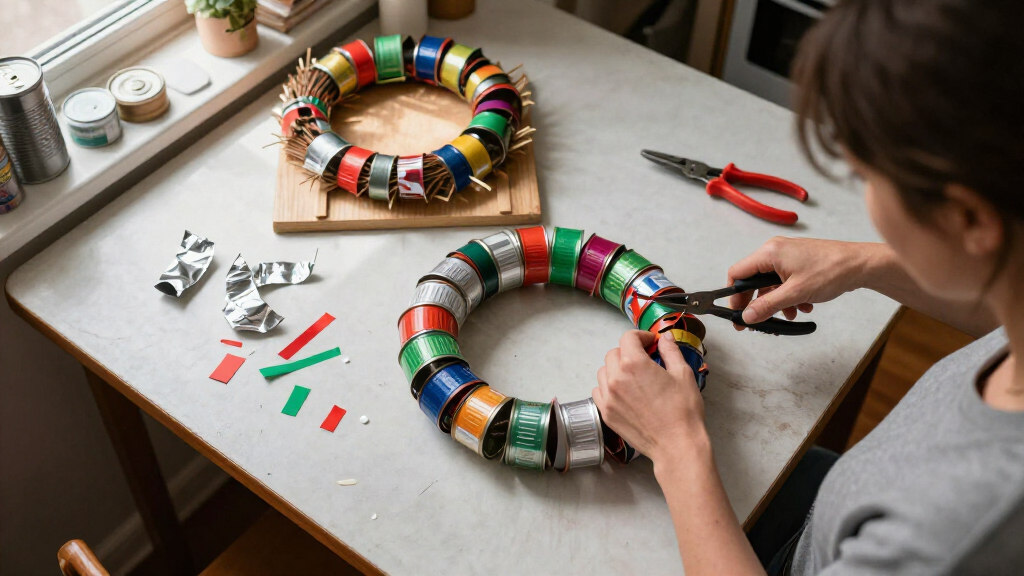
Hunker reports that DIYer Sharon L. Traylor made a front-door wreath from tin cans attached to wire, with the cans’ bottoms facing outward in alternating directions. The project reuses household materials, but the cans can be sharp and the finished wreath may be heavy, so safe handling and secure hanging matter.
DIYer Sharon L. Traylor made a front-door wreath from old tin cans, attaching them to wire with their bottoms facing outward in alternating directions. Hunker reported on the Facebook project as an unusual way to reuse cans for home decor, while noting that sharp edges and the wreath’s potential weight require care.
According to Hunker’s report, Traylor connected the cans with doubled fence wire threaded through holes in the cans. The alternating orientation creates a circular pattern that the report compares with floral wreath designs. The metal can contrast with a wooden door, giving the piece a rustic look without relying on a conventional wreath of leaves or flowers.
The construction involves flattening one end of each can with a hammer and making a hole with a drill so the cans can be secured to the wire. Hunker says a plain metal wreath form or a box-wire form could also be used, with the flattened ends inserted into the form and attached using an adhesive suitable for metal. It cautions that glue or tape may not hold the combined weight as reliably as a mechanical connection; the suitability of any method depends on the cans and materials used.
For an aged finish, Traylor reportedly used sandpaper, peroxide, sunlight and salt. Hunker also suggests paint as an alternative, including colors chosen to fit porch decor, a holiday or a sports team. The report does not provide measurements, a finished weight or a tested set of step-by-step instructions, so people adapting the idea would need to judge their materials and hanging setup for themselves.
Reusing Cans With Safety in Mind
The project puts reusable household packaging to a decorative use, and offers a low-cost idea for people who already have cans at home. That is a practical benefit, but the source does not quantify how many cans are diverted from waste or report any broader environmental effect. The story is best understood as a single DIY example, not evidence of a measurable reduction in landfill waste.
It also highlights trade-offs that can be easy to miss in a craft project. Tin cans may have sharp edges, and many cans connected together can make a wreath heavy enough to need a stronger hanger than a lightweight seasonal decoration. Anyone attempting the project should wear sturdy gloves and protective eyewear, keep other people clear of the work area, and use tools carefully. A secure attachment to the door matters as much as the appearance of the finished piece.
As an affiliate, we earn on qualifying purchases.
How the Can Wreath Is Assembled
Hunker presents Traylor’s wreath as an alternative to a standard floral design, using the cans’ metal surfaces and repeated circular arrangement to create its visual effect. The reported method depends on collecting enough cans, preparing them, and connecting them to a frame. Hunker notes that gathering a sufficient number may take several meals if a person does not already have cans available.
The report describes more than one possible build: wire threaded through drilled holes, or a wreath form that holds the flattened ends with an appropriate metal adhesive. It also offers two finish directions: encourage a rusty appearance using the method attributed to Traylor, or paint the cans. These are suggestions in the report, not independently tested instructions, and the article does not specify a particular can count, frame size or adhesive product.
““The original DIYer used doubled fence wire to string through the holes and connect her cans.””
— Hunker, reporting on the project
As an affiliate, we earn on qualifying purchases.
Details the Report Does Not Give
The source does not state when Traylor posted the project, how many cans she used, the wreath’s dimensions or its final weight. It also does not include a direct interview with Traylor or confirm whether the wreath has been tested outdoors, where weather could affect the cans, wire, paint or attachment points.
Hunker discusses possible alternatives, including adhesives, but does not report a comparison of their strength or durability. The best frame, attachment method and hanger would depend on the materials, the finished wreath’s weight and the door. The source also does not establish how much waste the project prevents; its reuse benefit is a reasonable purpose of the craft, not a measured outcome.
As an affiliate, we earn on qualifying purchases.
Planning a Safe Finished Wreath
Hunker’s report does not announce a follow-up or say that Traylor plans another version. For readers considering the idea, the immediate next steps are to collect cans, choose a stable wire frame and decide how to connect the prepared cans without exposing sharp edges. Use sturdy gloves and eye protection while flattening or drilling, and keep the work area clear. Check that the selected method can support the assembled wreath before hanging it.
Before putting the decoration on a door, assess its weight and use a hanger suited to that load; Hunker suggests an over-the-door hanger as one possible stronger option. The finished piece can be left with an aged-metal appearance or painted, but its durability and suitability for a particular door or outdoor location remain unreported. No further project results or testing are available in the source material.
As an affiliate, we earn on qualifying purchases.
Key Questions
Who made the tin-can wreath?
Sharon L. Traylor, a DIYer whose project was posted on Facebook, according to Hunker’s report.
How were the cans attached?
The report says Traylor used doubled fence wire threaded through holes in the cans. It also describes a wreath form and metal-appropriate adhesive as possible alternatives, but does not report testing those options.
What safety precautions are recommended?
Hunker recommends strong gloves and protective eyewear, along with a clear work area. Cans can have sharp edges, and tools such as a hammer and drill require careful handling.
Could the finished wreath need a stronger hanger?
Yes. Hunker says the connected cans may make the wreath heavy and suggests considering a stronger hanging method, such as an over-the-door hanger. The actual weight is not provided.
How can the cans be given a rusty appearance?
Hunker attributes a method using sandpaper, peroxide, sunlight and salt to Traylor. It also suggests painting the cans in colors that suit a porch or seasonal display.
Source: rss
Halloween Picks
halloween
As an affiliate, we earn on qualifying purchases.