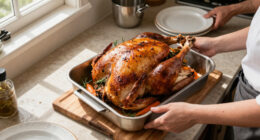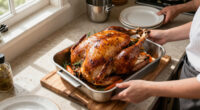
Choosing a turkey roasting pan is mostly a choice between long-term versatility and simpler ownership. Stainless steel pans handle high heat, tolerate metal utensils, and can go from oven to stovetop for gravy. Enamel-coated steel pans often cost less and clean up with less effort, but their coating needs more careful handling and can chip if knocked or scraped.

Get kitchen gear delivered free with Prime
- Fast, free delivery on millions of items
- Prime Video, Amazon Music and more included
- Member-only deals all year

Cuisinart Chef’s Classic 16 In. Roasting Pan with Rack, 7117-16URP1
- ✔ Material: Uncoated stainless steel with encapsulated aluminum base
- ✔ Pan dimensions: 20.7 × 12 × 4.9 inches
- ✔ Capacity: 731.14 cubic inches

EWFEN Roasting Pan, 17 × 13-Inch Stainless Steel Turkey Roaster with V-Shaped Rack and Flat Rack
- ✔ Material: Stainless steel, according to product description
- ✔ Listed pan dimensions: 17 × 12.6 × 5.9 inches
- ✔ Stated baking area: 17 × 13 inches

Turkey Roasting Pan with Lid, 18-Inch Enamel Carbon Steel Roaster
- ✔ Material: Enamel-finished carbon steel
- ✔ Exterior dimensions: 18 × 12.8 inches
- ✔ Interior dimensions: 15 × 11 inches
Both materials can roast a turkey well when the pan is large enough, sturdy, and fitted with a rack that holds the bird above its drippings. The real difference appears before and after roasting: stainless steel is the better tool for cooks who want to build fond and make gravy in the pan; enamel is appealing to occasional hosts who value an easy-release surface and a lower purchase price. The comparison below assumes conventional steel pans; enamel cast iron is heavier and has different heat-retention characteristics.
At a Glance
| Criteria | Stainless steel turkey roasting pan | Enamel-coated steel turkey roasting pan | Winner |
|---|---|---|---|
| Browning and pan gravy | Uncoated surface develops fond that can be deglazed for gravy | Can roast evenly, but fond formation and deglazing depend on the coating and manufacturer guidance | A |
| Cleanup | Baked-on drippings may take soaking or scrubbing | Smooth coating often releases food and wipes clean more easily | B |
| Durability | No coating to chip; quality stainless can serve for many years | Coating can chip from impacts or abrasive tools | A |
| Heat and stovetop use | Usually suitable for oven and stovetop use; check manufacturer limits | Oven-safe within stated limits; stovetop use is model-specific | A |
| Handling and weight | Often sturdy, with weight varying by gauge and construction | Often lighter than enamel cast iron; steel construction varies | Depends |
| Price and long-term value | Higher upfront price, often justified by repeated use | Usually lower initial cost, with replacement risk if coating is damaged | Depends |
| Best ownership fit | Frequent hosts and cooks who want a versatile pan | Occasional roasters prioritizing easier cleanup and price | Depends |
Cuisinart Chef’s Classic 16 In. Roasting Pan with Rack, 7117-16URP1
For a conventional holiday turkey, the Cuisinart is the most balanced pick in this group. Its uncoated stainless steel pan comes with a removable stainless steel rack, so the bird sits above the drippings while juices collect below for gravy. That setup is more straightforward than the EWFEN set’s choice between two rack styles, and it gives us a defined material and oven limit that the lidded enamel roaster’s description does not clarify as precisely.The listed dimensions are 20.7 inches long, 12 inches wide, and 4.9 inches high, with a stated capacity of 731.14 cubic inches. The length provides a useful reference when checking oven clearance, though the product listing does not specify the largest turkey weight it can hold. Its encapsulated aluminum base is intended to spread heat through the pan, while the nonreactive stainless cooking surface works for drippings and sauces. Induction compatibility and an oven rating of 500°F add flexibility beyond the enamel roaster, which excludes induction use.There are meaningful compromises. Stainless steel can show marks, and the manufacturer recommends hand-washing even though the pan is described as dishwasher-safe; poor dishwasher loading may mar or chip the finish. The handles also become hot, so mitts are necessary when moving a loaded pan. Choose this model if you want a durable, open roasting setup and clear compatibility details. Skip it if you specifically want a lid, a V-shaped rack, or a stated turkey weight limit before buying.
Pros:
- Removable stainless steel rack elevates the turkey above the drippings.
- Uncoated stainless steel cooking surface is described as nonreactive.
- Encapsulated aluminum base is designed for even heating.
- Induction-compatible and stated oven-safe to 500°F.
Cons:
- No maximum turkey weight is listed, so fit should be checked against the pan dimensions.
- Hand-washing is recommended to protect the finish despite the dishwasher-safe claim.
- Handles become hot during oven use and require mitts.
Best for: Cooks who want an open stainless steel roasting pan with a removable rack, gravy-catching space, and stated induction and oven compatibility.
Not ideal for: Buyers who need a covered roaster, a V-shaped rack, or a clearly specified maximum turkey weight.
Bottom line: Choose the Cuisinart for the clearest all-around open-roasting setup, provided its dimensions suit your bird and oven.
“Choose the Cuisinart for the clearest all-around open-roasting setup, provided its dimensions suit your bird and oven.”
EWFEN Roasting Pan, 17 × 13-Inch Stainless Steel Turkey Roaster with V-Shaped Rack and Flat Rack
EWFEN’s three-piece configuration is the most adaptable rack setup here. The set includes a deep pan, a V-shaped rack, and a flat rack. The V shape is intended to cradle poultry and keep it elevated; the flat rack gives us another arrangement for roasts or other oven dishes. Compared with the Cuisinart’s single rack, that choice may be useful if turkey is only one of several jobs for the pan. Its 3.5-inch rim is also described as helping contain sauces and drippings.The listed pan dimensions are 17 by 12.6 by 5.9 inches, with a 17-by-13-inch baking area also stated in the description. Since those figures do not align exactly, we should verify the actual usable footprint if oven clearance or bird fit is close. The Cuisinart is longer at 20.7 inches, which may suit a larger bird or provide more room, while EWFEN is a more compact option on the listed exterior length. The manufacturer calls the construction heavy-duty stainless steel and describes welded rack wires, but does not provide an oven temperature limit or a turkey weight capacity.One point deserves care: the description calls the pan and racks stainless steel, yet also describes a “superior non-stick coating” and mirror finish without clearly identifying a coating material or care limit. That ambiguity makes the surface harder to evaluate than Cuisinart’s explicitly uncoated steel. The listed weight is 3.63 kg, so this is not necessarily a light pan once loaded. Choose EWFEN if its two rack styles solve a real cooking need; choose Cuisinart if you prefer clearer material and temperature guidance.
Pros:
- Includes V-shaped and flat rack options.
- Deep rim is intended to contain drippings and sauce.
- V-shaped rack is designed to stabilize poultry while elevating it.
- Can serve for other oven dishes as well as roasting.
Cons:
- Description gives inconsistent pan-area dimensions and no maximum turkey weight.
- Non-stick coating claim is not clearly reconciled with the stainless steel material description.
- No oven temperature limit or specific cooktop compatibility is provided.
Best for: Cooks who want both a V-shaped poultry rack and a flat rack in one roasting set, and whose oven can accommodate the listed footprint.
Not ideal for: Buyers who need a published oven-safe temperature, a stated turkey weight limit, or unambiguous information about the cooking surface.
Bottom line: Pick EWFEN when rack versatility matters more than the Cuisinart’s clearer material and temperature specifications.
“Pick EWFEN when rack versatility matters more than the Cuisinart’s clearer material and temperature specifications.”
Turkey Roasting Pan with Lid, 18-Inch Enamel Carbon Steel Roaster
This is the lineup’s only lidded roaster, making it the most distinct choice rather than a direct substitute for the open Cuisinart or EWFEN pans. Its oval enamel carbon steel body and lid are designed for covered poultry cooking, and the listing states that it can hold up to 16 pounds of poultry with the lid. That gives buyers a capacity reference missing from the other two listings. The Cuisinart and EWFEN sets instead focus on raised racks and an open pan for browning and collecting drippings.The product is listed as 18 inches long and 12.8 inches wide, with interior dimensions of 15 by 11 inches. Those interior measurements matter more than the exterior length when checking a turkey’s footprint, so we should compare them with the bird and allow room for the lid. The description says it is dishwasher-safe and identifies a carbon steel core with an enamel finish. It also states a maximum temperature of 932°F, but that unusually high figure should be confirmed against the manufacturer’s instructions for the specific model before use. By comparison, Cuisinart gives a lower but clearly stated 500°F limit, and EWFEN provides no temperature limit.The main tradeoff is versatility. There is no included rack listed, so buyers seeking the elevated support used by the other two options may need a separate compatible rack or prefer an open pan. The roaster is expressly unsuitable for induction cooktops, glass ovens, and microwaves, which sharply narrows compatibility. Its covered format also means less direct exposure during roasting than an open rack setup. Choose it when a lid and stated 16-pound capacity fit your cooking plan; skip it if you rely on induction or want a rack included.
Pros:
- Lid supports covered roasting, a feature absent from the other two picks.
- Manufacturer states capacity for poultry up to 16 pounds with the lid.
- Interior dimensions are provided for checking bird fit.
- Enamel carbon steel construction is described as dishwasher-safe.
Cons:
- Not suitable for induction cooktops, glass ovens, or microwaves.
- No roasting rack is listed as included.
- The stated 932°F maximum temperature should be verified in the product instructions.
Best for: Cooks who want a lidded oval roaster for covered turkey cooking and whose turkey fits within the stated 16-pound capacity and interior dimensions.
Not ideal for: Induction users, anyone with a glass oven, or buyers who want an included rack for open roasting and browning.
Bottom line: Choose this roaster for covered cooking only when its compatibility limits and interior size match your kitchen and turkey.
“Choose this roaster for covered cooking only when its compatibility limits and interior size match your kitchen and turkey.”
As an Amazon Associate we earn from qualifying purchases.
Key Differences
The strongest practical advantage of stainless steel is what happens to the browned bits left after roasting. They can be loosened with liquid on the stovetop and incorporated into gravy, giving the pan a second job. Enamel-coated steel can roast a turkey effectively, but whether it is suitable for burner use and deglazing varies by model. Its smooth finish tends to make cleanup easier, a real benefit after a large meal.
Durability also separates the materials. Stainless steel has no coating to chip, while enamel can be damaged by impact, sudden temperature changes, or unsuitable utensils. That does not make every stainless pan indestructible: thin construction can warp, and poor-quality handles or racks can fail. For either material, check the maker’s care instructions, oven rating, burner compatibility, dimensions, and rack design.
Price alone does not settle the value question. A modestly priced enamel pan can be sensible for one or two holiday meals a year, especially if easy cleaning matters most. A well-built stainless pan costs more upfront, but pays off for regular roasting, stovetop gravy, and other oven-to-stove tasks. Pay the premium when you will use those capabilities; otherwise, a sound enamel pan may be the better buy.
Detailed Comparison
Browning and pan gravy (Stainless steel turkey roasting pan wins — moderate)
Stainless steel wins by a moderate margin for cooks who make gravy from the roasting drippings. Its bare cooking surface can collect fond, which can be loosened with stock, wine, or water on a compatible stovetop. Enamel can brown food, but its finish may produce a different amount of fond, and the pan may not be approved for burner use. Check the instructions before putting any roasting pan over a flame or burner. If gravy is central to the meal, stainless is the more reliable pick.
Cleanup (Enamel-coated steel turkey roasting pan wins — moderate)
Enamel wins by a moderate margin for routine cleanup. Its smooth surface often releases drippings more readily, so soaking and washing can take less work. Burned-on sugars and fats can still stick, and abrasive scrubbers may scratch or dull some finishes. Stainless can require more soaking or scrubbing after roasting, but it tolerates more vigorous cleaning when the manufacturer allows it. Choose enamel if post-dinner cleanup is a major concern; choose stainless if you are comfortable with a little extra effort.
Durability (Stainless steel turkey roasting pan wins — major)
Stainless steel wins by a major margin in resistance to surface damage. There is no enamel layer to chip if the pan is knocked against a counter or the rack is handled roughly. Good stainless construction can last through years of seasonal use, though thinner pans may warp and any pan can have weak handles or joints. Enamel is perfectly usable with careful storage and nonabrasive tools, but a chip can expose the steel beneath and leave the finish vulnerable to further damage. For a pan meant to become a kitchen staple, stainless is the safer investment.
Heat and stovetop use (Stainless steel turkey roasting pan wins — moderate)
Stainless steel wins by a moderate margin for oven-to-stove cooking, provided the handles and construction are rated for both. Many stainless roasting pans can be placed over burners to reduce drippings into gravy. Enamel-coated pans vary: some are oven-only, while others permit specific stovetop use. Follow the product’s temperature and burner guidance, and avoid abrupt temperature changes that can stress an enamel coating. For cooks who want one pan to roast and finish a sauce, stainless offers more predictable versatility.
Handling and weight (minor difference)
There is no universal winner, so this is a minor difference that depends on the exact pan. Enamel-coated steel is often manageable, but enamel cast iron is substantially heavier; stainless weight depends on its gauge and base. A large turkey pan becomes awkward when filled with a bird and hot juices, regardless of material. Compare empty weight, handle shape, handle clearance with oven mitts, and whether the rack sits securely. Choose the pan you can lift safely from oven to counter.
Price and long-term value (moderate difference)
The better value depends on use frequency, a moderate difference. Enamel-coated steel usually has the lower entry price, so it makes sense if the pan will come out once or twice a year and its coating stays intact. Stainless usually costs more, but its durability and stovetop usefulness can justify the premium for frequent hosts or cooks who use roasting pans for other dishes. Pay more for stainless when you will use its versatility; for occasional roasting alone, the added cost may not return enough value.
Best ownership fit (moderate difference)
Neither material wins for every household, a moderate difference driven by cooking habits. Stainless suits cooks who roast often, make gravy in the same pan, and want a pan that can take regular use. Enamel suits occasional hosts who prefer simple cleanup and a lower initial price, and who are willing to avoid impacts and abrasive tools. A pan’s size, rack, oven rating, and sturdy construction matter as much as its finish; a poor fit in those areas can outweigh the material advantage.
Stainless steel turkey roasting pan: Pros and Cons
Pros:
- Uncoated surface is well suited to fond and stovetop gravy.
- No enamel layer to chip or scratch through.
- Often compatible with oven-to-stovetop cooking when rated by the maker.
- Useful for roasting and other large-batch oven cooking.
Cons:
- Usually costs more upfront.
- Baked-on drippings can take more work to remove.
- Thin or poorly constructed pans may warp under heat.
- Weight and handle comfort vary; a loaded pan can be difficult to lift.
Enamel-coated steel turkey roasting pan: Pros and Cons
Pros:
- Usually lower priced than comparable stainless steel.
- Smooth surface can make food release and cleanup easier.
- Can roast a turkey effectively when correctly sized and used within its rating.
- May suit occasional holiday use without paying for extra versatility.
Cons:
- Enamel can chip after impacts or rough handling.
- Abrasive cleaning tools may damage the finish.
- Burner compatibility varies, limiting gravy preparation in the pan.
- Damage to the coating can shorten the pan’s useful life.
Who Should Choose What
Choose Stainless steel turkey roasting pan if:
- You roast often and want a pan that can handle repeated use.
- You make gravy from the browned drippings on the stovetop.
- You want a cooking surface with no coating to chip.
- You will also use the pan for large roasts or other oven-to-stove dishes.
Choose Enamel-coated steel turkey roasting pan if:
- You roast a turkey only occasionally and want to spend less upfront.
- Easy food release and less cleanup matter more than stovetop gravy.
- You are willing to use nonabrasive tools and store the pan carefully.
- The exact pan’s oven rating, dimensions, and rack meet your needs.
Skip both if: Skip both materials if neither model fits your oven or turkey, lacks a stable rack, or feels unsafe to lift when loaded; choose a sturdier pan with suitable dimensions and handles.
Value for Money
Stainless steel is worth paying more for when the pan will see regular use or when you want to deglaze the roasting juices directly on the stovetop. Its lack of a coating reduces one common source of damage, and its versatility can replace a single-purpose roasting dish. That premium has little value if the pan spends most of the year in storage and you do not make pan gravy.
For occasional holiday cooking, enamel-coated steel can offer better value at a lower upfront price, particularly for someone who values a surface that is easy to wash. Treat the coating gently and verify burner compatibility before buying. Whichever material you choose, spend first on a pan that fits your oven and bird, has a stable rack, and provides secure handles. A well-sized, soundly built pan is a better purchase than a pricier one that is awkward or too small.
Final Verdict
For most cooks who host regularly, choose a well-built stainless steel turkey roasting pan. Its durability and ability to support oven-to-stovetop gravy make it the more versatile long-term choice, and those benefits justify paying more when you will use them. Choose enamel-coated steel if you roast only occasionally, want easier cleanup, and prefer a lower purchase price; handle it gently and check its burner rating. The deciding factor is whether you will use the pan for gravy and repeated cooking. If yes, buy stainless. If no, a properly sized enamel pan is a sensible value.
Frequently Asked Questions
Which pan is better for making turkey gravy?
Stainless steel is usually the better choice because its uncoated surface can collect browned bits that are loosened into gravy. Confirm the pan is rated for your stovetop before using it over a burner.
Is an enamel-coated roasting pan safe to use on the stove?
It depends on the specific model. Some are intended for oven use only, while others permit certain stovetop burners. Check the manufacturer’s instructions and avoid rapid temperature changes that could damage the coating.
Does stainless steel roast a turkey better than enamel?
Not automatically. Either can roast a turkey well if it fits the bird, has a stable rack, and is used within its temperature rating. Stainless has an advantage for gravy and long-term surface durability; enamel often has an advantage in cleanup.
Is stainless steel worth the higher price?
It is worth paying more if you roast regularly, want to make gravy in the pan, or will use it for other oven-to-stove cooking. For a turkey once a year and no stovetop finishing, an undamaged enamel pan can be better value.