The best kitchen gear does more than add another appliance to the counter. It makes everyday cooking easier, fits the space you actually have, and supports the meals you genuinely prepare. That may mean an air fryer for quick dinners, a compact multicooker for travel, a thermal cooker that works without continuous power, or a drying rack that gives a crowded kitchen more usable workspace.
Choosing well can be difficult because kitchen products are often compared by long feature lists rather than real-life usefulness. A large capacity sounds appealing until the appliance overwhelms the counter. A highly specialized tool may perform one task beautifully but spend most of the year in a cabinet. Meanwhile, a simple mug, rack, or portable appliance can become indispensable when it solves a recurring problem.
This guide explains how to evaluate cooking appliances, space-saving accessories, portable kitchen equipment, and cleanup tools. Use it as a starting point, then follow the linked guides for deeper comparisons in the category that matches your needs.
Start With Your Kitchen, Not the Appliance
Before comparing models, identify the limits of the environment in which the product will be used. A conventional home kitchen, studio apartment, recreational vehicle, boat, hotel room, and campsite all impose different constraints. Available counter space is only one factor. Storage, electrical capacity, ventilation, access to water, and the number of people being served may matter just as much.
Measure the intended location rather than estimating it. Include the space needed to open lids, remove baskets, connect hoses, or reach controls. An appliance that technically fits beneath a cabinet may still be awkward if steam rises directly into the cabinetry or the lid cannot open fully.
Next, consider frequency. Equipment used every day should be easy to access, clean, and operate. A product intended for occasional trips can prioritize portability and compact storage. If an appliance is difficult to retrieve or assemble, it is less likely to earn a regular place in your routine.

CHEFMAN 2 Qt Mini Air Fryer – Digital Space-Saving Compact Air Fryer with Nonstick and Dishwasher Safe Basket, Quick & Easy Meals in Minutes, Features Digital Timer and Shake Reminder – Black
- Fast Cooking: Cooks up to 3 times faster than oven
- Healthy Meals: Uses little to no oil for healthier cooking
- Space-Saving Design: Compact square basket with narrow profile
As an affiliate, we earn on qualifying purchases.
As an affiliate, we earn on qualifying purchases.
Choosing Countertop Cooking Appliances
Match the cooking method to your meals
Countertop appliances are most useful when their core cooking method suits foods you already enjoy. Air fryers circulate hot air and are often chosen for browning, reheating, and cooking smaller portions without operating a full-size oven. Multicookers are designed around flexibility, combining several cooking modes in one footprint. Microwaves prioritize speed, while slow and thermal cooking methods emphasize unattended cooking and heat retention.
Think in terms of recurring jobs. Do you want to reheat leftovers without making them soggy, prepare rice and one-pot meals, cook while traveling, or reduce dependence on a conventional stove? One appliance that handles several frequent tasks is usually more valuable than a feature-packed machine whose functions rarely match your menu.
Capacity requires context
Capacity labels are not always directly comparable because usable cooking space depends on the appliance’s shape. A wide basket may accommodate foods in a single layer more effectively than a deeper but narrower chamber. A multicooker must have enough room for ingredients while still allowing safe operation within its fill limits.
Estimate the portions you normally cook and whether you are willing to work in batches. A compact appliance can be ideal for one or two people, but repeated batches may erase its convenience for a larger household. Conversely, oversized equipment can consume valuable space and take more effort to clean when most meals are small.
Materials and food-contact surfaces
Shoppers increasingly pay attention to cooking surfaces, removable liners, and coating materials. The right choice depends on preferences for food release, maintenance, durability, and cleaning. No surface is maintenance-free: cookware and appliance inserts generally last longer when used with suitable utensils and cleaned according to the manufacturer’s instructions.
If cooking-surface materials are a priority, begin with this comparison of air fryers with ceramic coating. Beyond the coating itself, consider basket dimensions, removable components, temperature controls, and how easily food residue can be reached during cleaning.

Crock-Pot MultiMeal Multicooker and Programmable Slow Cooker with Bake Function, Create 2 Dishes Simultaneously, Two 3.7qt Nonstick Pots Feed 8+ People, Dishwasher-Safe
- Multiple Cooking Functions: Slow cook, sear, bake, steam, keep warm
- Dual-Pot Design: Cook two dishes simultaneously
- Smart Timer Technology: Ensures both dishes finish together
As an affiliate, we earn on qualifying purchases.
As an affiliate, we earn on qualifying purchases.
Air Fryers for Small and Mobile Kitchens
Air fryers can be especially attractive in compact kitchens because they combine a relatively small footprint with fast countertop cooking. However, small-space buyers need to look beyond exterior dimensions. Heat clearance, cord placement, basket access, ventilation, and storage all affect whether an appliance works comfortably in a restricted layout.
RV users face an additional concern: electrical load. An appliance should be evaluated within the limits of the vehicle’s electrical system and alongside any other devices that may operate at the same time. Stable placement is also important in a mobile environment, and the appliance must be cool, clean, and secured before travel.
The guide to air fryers for RV campers provides a focused route through the category. Use it while keeping your own available wattage, counter dimensions, storage location, and typical serving size in mind. An RV-friendly choice is not simply the smallest machine; it is one that fits the complete cooking and travel routine.

Tayama Stainless Steel Thermal Cooker,Black,7 Qt.,TXM-70CFZR
- Capacity: 7 Qt.
- Energy Efficient: Saves 80% energy
- Versatile Use: Ideal for gatherings and outdoor
As an affiliate, we earn on qualifying purchases.
As an affiliate, we earn on qualifying purchases.
Portable and Off-Grid Cooking
Multicookers for travel
Travel cooking equipment must balance versatility against weight and bulk. A portable multicooker can support rice, soups, grains, and other one-pot meals without requiring a full kitchen setup. That can be useful in accommodations where permitted, in an RV, or anywhere a compact cooking station is needed.
Before traveling with an appliance, verify the rules at the destination. Some hotels, dormitories, workplaces, and shared spaces restrict cooking devices. Electrical compatibility also matters when crossing regions. Voltage, plug type, and power requirements should be confirmed rather than assumed.
For a category overview, explore these portable multicookers for travel. Compare them based on packed dimensions, useful cooking modes, control simplicity, cleaning requirements, and whether the capacity aligns with the number of travelers.
Thermal cooking without continuous electricity
A thermal cooker uses retained heat to continue cooking after food has been heated, reducing the need for continuous energy input. This method may suit soups, stews, grains, and other recipes compatible with gradual cooking. It can be appealing for energy-conscious routines, travel setups, or situations where maintaining an active heat source is inconvenient.
Thermal cooking requires planning and careful attention to food safety. Ingredients must be heated appropriately before entering the insulated container, and time and temperature guidance should be followed. It is not a direct substitute for every stovetop, pressure-cooker, or slow-cooker recipe.
To understand the available formats, see the guide to non-electric thermal cookers. Pay particular attention to vessel size, insulation, portability, lid design, and the instructions provided for safe use.
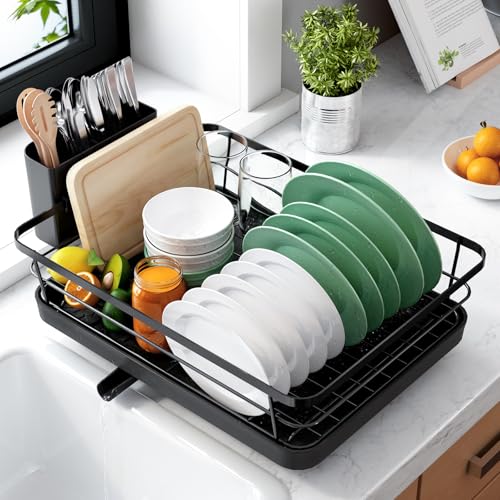
Kitsure Dish Drying Rack for Kitchen Counter, 12''W x 15.5''L, Black
- Compact Size: 12''W x 15.5''L, 5-inch height
- Space-Saving Design: Fits limited kitchen counter space
- Capacity: Holds 10 plates, bowls, glasses
As an affiliate, we earn on qualifying purchases.
As an affiliate, we earn on qualifying purchases.
Simple Tools for Faster Individual Meals
Not every kitchen problem requires a major appliance. Small food containers can make reheating and portion management easier while taking up little storage space. For people who bring lunch to work, cook single servings, or frequently reheat soup, a purpose-designed microwave vessel may be more practical than a larger countertop machine.
A useful soup mug should be comfortable to handle and appropriately sized for the intended portion. Its lid design, venting instructions, microwave suitability, and cleaning guidance all deserve attention. Liquids can become extremely hot, so users should leave suitable headspace, follow heating directions, and open lids carefully to avoid steam.
This roundup of microwavable soup mugs with lids is a helpful place to compare options for home, office, or packed meals. Check whether every component is intended for microwave use and whether the container’s shape is easy to clean.
Making a Small Kitchen Work Better
Protect usable counter space
Counter space should be treated as a limited working resource. Appliances that remain permanently on the counter need to justify their footprint through frequent use. Less-used equipment can be stored, but only if it is light enough and accessible enough to retrieve safely.
Consider organizing the kitchen around activity zones. Keep preparation tools near the main work surface, cooking equipment near safe electrical outlets, and cleanup accessories near the sink. Avoid placing high-heat appliances where they interfere with water, hanging fabrics, or overhead storage.
Use the sink area vertically
Drying dishes can consume a surprising amount of workspace. An over-the-sink rack uses the sink zone rather than occupying a separate section of counter. This approach may be useful in apartments, RVs, and other compact kitchens, but accurate measurements are essential.
Measure the sink’s width, depth, faucet position, and surrounding ledges. Also consider whether the rack will interfere with washing, whether water can drain freely, and how much weight the setup can safely support. The guide to over-the-sink dish drying racks can help narrow the available styles before you compare them with your sink dimensions.
Cleanup Equipment for Boats and Other Tight Spaces
Marine kitchens introduce challenges that ordinary countertop comparisons may overlook. Space is limited, surfaces can move, freshwater may be conserved, and drainage requires careful planning. Any appliance used aboard a boat should suit the vessel’s power, water, ventilation, and storage arrangements.
Portable dishwashers vary in how they receive and discharge water. Before choosing one, investigate the complete setup: where the unit will sit, how it will be filled or connected, where wastewater will go, and how the appliance will be secured when not operating. Capacity should be considered in relation to the cookware and place settings used aboard, not merely the number shown in a description.
Start with the guide to portable dishwashers for boats, then confirm installation and operating requirements against the vessel’s systems. On a boat, compatibility is more important than convenience features that may never be usable.
How to Compare Kitchen Gear Responsibly
Prioritize specifications that affect daily use
Focus first on dimensions, capacity, power requirements, temperature or program controls, and cleaning access. Then consider secondary features such as presets, displays, included accessories, and visual design. Extra functions can be worthwhile, but only when they simplify tasks you already perform.
Read the manufacturer’s current manual before purchasing when possible. Manuals often reveal clearance requirements, circuit guidance, fill limits, cleaning restrictions, and operating steps that are not obvious from a short listing. They can also show whether the appliance will be comfortable for everyone expected to use it.
Account for the full ownership experience
The purchase decision should include more than cooking performance. Consider where parts will dry, whether removable components fit in the sink, how the cord is stored, and whether crumbs, grease, or condensation can be reached easily. If a product has multiple accessories, decide where those pieces will live when they are not in use.
Also think about overlap. If you already own a dependable oven, rice cooker, or pressure cooker, a new appliance should solve a distinct problem or provide meaningful convenience. Avoid buying several devices for the same occasional task unless you have the storage and a clear use case for each.
Build a Kitchen Around Real Habits
A practical kitchen is not defined by how many tools it contains. It is defined by how smoothly those tools support preparation, cooking, serving, and cleanup. Begin with the recurring friction in your routine: limited oven access, slow weeknight meals, insufficient workspace, difficult travel cooking, or piles of drying dishes. Then choose the smallest, simplest solution that addresses that problem reliably.
For quick countertop cooking, investigate coated air fryers or RV-oriented models. For flexible meals away from a full kitchen, compare portable multicookers and thermal cookers. For individual lunches, a microwave-safe soup mug may be sufficient. When space and cleanup are the larger problems, focus on sink-spanning racks or a carefully matched portable dishwasher.
Measurements, power compatibility, food safety, maintenance, and realistic capacity are the common threads across every category. When those fundamentals are right, kitchen gear becomes easier to use and easier to live with—whether the kitchen is in a house, a tiny apartment, an RV, or on the water.