
TL;DR

Get kitchen gear delivered free with Prime
- Fast, free delivery on millions of items
- Prime Video, Amazon Music and more included
- Member-only deals all year
A Hunker report describes using open, empty egg cartons as removable compartments on rolling storage carts. The carton cups can sort small supplies, while the lid can serve as a tray; the idea is inexpensive when cartons are already on hand, but durability and fit depend on the carton and its use.
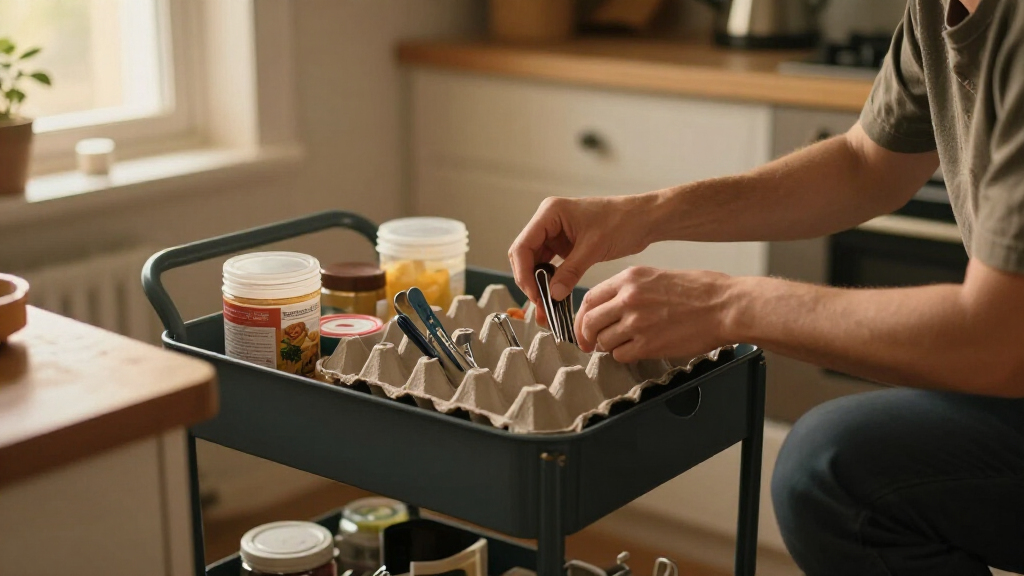
Hunker has reported a low-cost way to organize rolling storage carts: place an open, empty egg carton on a shelf and use its molded cups to separate small items such as beads, craft supplies or office materials. The idea repurposes packaging many households already have, rather than requiring purpose-made bins.
The method requires little preparation: open the carton, set it on a cart shelf and assign items to its individual cups. Hunker notes that the compartments can suit small supplies that are difficult to sort in deep cart shelves, including paint and craft materials, small office supplies, beads and jewelry. The carton lid can also function as a broader tray, while the raised dividers between cups may hold items such as rubber bands or bracelets.
The report says users can place several cartons on a shelf, leave part of the shelf open or cut a carton to fit a smaller space. Glue dots or nonslip shelf liner can help prevent it from sliding. Hunker also suggests decorating cardboard cartons with paint, ribbon or decoupage; these are optional additions, not requirements for the basic organizer.
For people who do not have spare cartons, Hunker suggests asking friends or family to save them, or buying cartons. It describes molded-pulp cartons as a protective, more eco-friendly option, but offers no comparative testing or durability data. A ceramic egg holder is another, more durable alternative mentioned in the report, though it costs more than reusing packaging.
A No-Cost Option for Small Supplies
The suggestion addresses a practical mismatch: rolling carts often have broad, deep shelves, while many items people store on them are too small to stay sorted. Reusing a carton can create several small compartments without buying a set of organizers, making the approach useful for craft tables, home offices or other spaces where small objects collect.
The savings depend on already having a suitable carton. The report does not compare costs, show how long cartons last, or establish that they work better than other repurposed containers. Still, the approach is adjustable: cartons can be moved, combined or cut to fit, and users can leave open shelf space for larger items.
Products Worth Considering

Ninja Foodi Air Fryer 8 Qt DualZone 6-in-1 Grey DZ201

Le Creuset Enameled Cast Iron Rectangular Roaster, 5.25 qt, Nectar

Ninja DualZone Air Fryer 10 Qt Smart 6-in-1 Grey
As an affiliate, we earn on qualifying purchases.
How the Carton Fits the Cart
Hunker frames the idea as one use for rolling storage carts such as the IKEA Raskog and similar designs. Their shelves can hold a mix of objects, but loose small supplies may be harder to keep arranged than larger items. An egg carton supplies ready-made cups, making it a simple insert rather than a permanent modification to the cart.
The report also places the tip among broader ways to reuse empty cartons around the home. Its central distinction is between repurposing what is already available and buying organizers designed for storage. It does not report a product launch, formal test or new study; this is a household advice item based on a suggested DIY method.
“The answer could be in your refrigerator right now: egg cartons.”
— Hunker
Durability Depends on Use
The source provides no testing of how long a carton lasts on a cart, how much weight it can hold or how it performs around moisture and spills. Cardboard and molded-pulp cartons may be less durable than rigid plastic or ceramic storage, but the report does not quantify that difference. It is also unclear how well particular cartons will fit different cart shelves; sizes and layouts vary.
The report’s environmental and protective comparisons are presented as general guidance, not as results from a cited study. Readers should treat the organizer as a reuse idea for suitable lightweight items, rather than a tested replacement for durable storage containers.
Try the Fit Before Filling
Anyone trying the method can start by checking that a clean, dry carton sits securely on the intended shelf. Add lightweight items, then test whether the carton slides when the cart moves; Hunker suggests glue dots or shelf liner if needed. Cutting, decorating and color-coding are optional ways to tailor the organizer, but the source reports no follow-up testing or scheduled next development.
The practical next step is to judge the carton against the items being stored and the conditions of the space. For supplies that need more protection or frequent handling, a sturdier container may be more appropriate. No additional measurements, product comparisons or independent evaluations are included in the report.
Key Questions
How do you use an egg carton in a storage cart?
Open an empty carton and place it on a cart shelf. Use the molded cups to separate small items; the lid can serve as a larger tray.
What can the carton hold?
Hunker suggests small craft and office supplies, beads, jewelry and similar lightweight items. The report does not test weight limits.
How can you stop the carton from sliding?
The report suggests adding glue dots or nonslip shelf liner underneath. Check that the carton stays in place before filling it.
Are egg cartons durable enough for long-term storage?
The source does not provide durability tests or a recommended lifespan. Carton material, moisture and frequency of handling may affect how well one holds up.
Do you need to buy cartons for this idea?
No. The suggestion is to reuse an empty carton already available or ask friends and family to save one. Buying cartons is another option, but adds a cost.
Source: rss